11 November 2011

—1898—
A Shaker's Advice on Farming

#63

This barn is in Hancock Shaker Village in Pittsfield, Massachusetts. It was built in 1826 and is a well-preserved agrarian treasure.


Richard Van Deusen, of Enfield, Ct., entertained the Institute most of the forenoon by reading a paper in which he made many shrewd and quaint comments. He said that the Shakers require all that join them to be fair and square with God and man as far as possible; so the first step for any farmer who wishes to start right is to find out where he stands. He counseled his brother farmers to look after their wood-piles in the leisure months and see that there was a good supply cut and housed for the rest of the year. The manure heaps should receive attention and not be allowed to waste under the eaves of the barn. As a rule the dealers in commercial fertilizers are growing rich, and the farmers who use them are growing poor. The cows should be kept in thrifty condition. A poor cow gives poor milk. Shaker cows get roots, meal and good hay daily, and they show it in their looks and products. A peck of yellow globe turnips, from their bin of 1,800 bushels, is given each animal daily, with four quarts of a mixture of meal and wheat shorts. He thought sheep raising was one of the best branches of farming for the hill-towns. Sheep give two returns of profit a year. He had known lambs in Lebanon, N.Y., sell for six dollars a head, and the dams shear from three to eight pounds of wool each. It is difficult to raise lambs from feeble sheep. He said the winter is a good time to put farm tools in order. One of the first spring exercises with some farmers is sowing oats, He would get a good kind, sow three bushels to an acre, and cover them two and a half inches deep with a seed drill. He had ploughed them in. They yield better when well covered. Oats that weigh 32 to 35 pounds to the bushel are alone fit to sow or feed, and the yield should not be less than 50 bushels an acre.

Potatoes should be planted early in order to get the benefit of the spring rains and a good market price. Turf land gives the best results, and he would plow the fall before. As soon as the tops show signs of decay, which is often early in July, he digs, barrels and covers them in his barns. The Blush variety had tops as large as a four-quart measure last year when the frost came, and though they were badly cut, he dug about 300 bushels an acre. Of corn, he would not raise less than 50 to 75 bushels an acre. We have not the 300-acre fields of corn found in Ohio, but in our little way we can raise more bushels to an acre and a better quality than they can in the west. All things considered, he thought hay was the most profitable crop, and with machinery he could cut, cure and cart it for $2 a ton. He would plow some grass lands, once in three or four years, put on 15 to 20 cart-loads of manure, or some phosphate, and seed with half a bushel of Timothy to the acre, harrowed and rolled in. In this way he expects three tons of hay from an acre, taking both crops. He once cut 22 tons of hay on six acres and sold it at $40 a ton. He would not pasture his meadows any more than he would run in debt. He thought that tools might be kept to let like horses in a livery-stable. Few farmers can afford to keep all the machinery they need. Labor is an important factor in farming, and hired help should receive fair wages when due; but too many give their help the cream, and consequently the farmer and his family have to put up with the skim-milk. Parents were exhorted to make home pleasant, and speak gently to the members of the family. Find out what the boys are adapted to before you overload them, and when they get into trouble help them out. A scar is not easily healed on man or a tree. He has a favorite horse that he speaks as gently to as to his mother or sister, and the horse knows it.
[Leavitt’s Farmer's Almanac]

A view inside the round barn at Hancock Shaker Village. Click Here to learn a little more about the barn.

###

==========
If you appreciate  Agrarian Nation, please consider supporting this web site with a modest donation of $4.95 a year.  Click Here For Details
==========

04 November 2011

-1849-
November
Farmer's Calendar Excerpt
(A Recipe For Easy Circumstances)

#61


-1849-
Would you like to know how you can always be in easy circumstances? If so, here—take the recipe:

Subdue every unnecessary want or desire, and buy only such things as will add to your real comfort and convenience. 

It is the extreme of folly to think you must buy every thing you see, or have everything that some of your rich neighbors have. If they have attained their wealth by their vices, their exhortations and rogueries, do not try to ape them, but despise alike their means and their ends. If they have acquired their riches by their virtues, their fairdealing and activity and honesty, in business, as only the truly self-made men, the great and excellent of the earth, ever do, they deserve your regard and esteem—they are to be honoured—they are worthy of their success—the community at large will benefit by their prosperity; you will not envy them, nor make vain and fruitless attempts to rival them in their establishments and equipages; but pursue the even  tenor of your way in right-thinking and right-acting, as these noblemen of Nature’s fabric have done before you. 

The frog, in trying to swell to the size of the ox, burst—a certain end to all artificial greatness. Whenever you find you can curtail your expenses, you must summon resolution to do it.
[Maine Farmer's Almanac]


###

It is November in the Agrarian Nation. The crops are harvested. The farmer has some profit. And the Maine Farmer's Almanac has some sage advice... live within your means. 

Now there is some wisdom as appropriate to today as it was 162 years ago.

Fathers and mothers, if you want to pass on wisdom to your children, may I suggest that you arm yourself with an arsenal of aphorisms, and use them often through the years, when the occasion warrants. Your children will grow up, and they will remember...

My momma always used to tell me...

"The frog, in trying to swell to the size of the ox, burst."

### 


I'm wondering, can you think of an aphorism that your father or mother or a grandparent used to say?


###

==========
If you appreciate  Agrarian Nation, please consider supporting this web site with a modest donation of $4.95 a year.  Click Here For Details
==========

31 October 2011

A Short Break

I missed posting an Agrarian Nation excerpt here on Friday (did anyone notice?) and am also not posting one today. But I will be back on track for the next installment this coming Friday. In the meantime, I invite you to read my monthly Deliberate Agrarian "blogazine" post for October, which I have put online just this morning. Here's the link: The Deliberate Agrarian: October 2011

24 October 2011

—1861—
Jerusalem Artichokes


Jerusalem Artichoke Tubers (photo link with article )

The following information comes to us from The Book of Household Management, by S.O. Beeton, published in 1861.

In the front of the book we find this tidbit of wisdom...

Nothing lovelier can be found 
In Woman, than to study household good.
—Milton

###

Roasted Jerusalem Artichokes (photo link with recipe)


The Jerusalem Artichoke
This plant is well known, being, for its tubers, cultivated not only as a garden vegetable, but also as an agricultural crop. By many it is much esteemed as an esculent, when cooked in various ways; and the domesticated animals eat both the fresh foliage, and the tubers with great relish. By some, they are not only considered nourishing, but even fattening.
.
Uses of the Jerusalem Artichoke
This being a tuberous-rooted plant, with leafy stems from four to six feet high, it is alleged that its tops will afford as much fodder per acre as a crop of oats, or more, and its roots half as many tubers as an ordinary crop of potatoes. The tubers, being abundant in the market-gardens, are to be had at little more than the price of potatoes. The fibres of the stems may be separated by maceration, and manufactured into cordage or cloth; and this is said to be done in some parts of the north and west of France, as about Hagenau, where this plant, on the poor sandy soils, is an object of field culture.


Recipe For
Boiled Jerusalem Artichokes
Ingredients: To each 1 gallon of water allow 1 heaped tablespoonful of salt; artichokes.
.
Mode: Wash, peel, and shape the artichokes in a round or oval form, and put them into a saucepan with sufficient cold water to cover them, salted in the above proportion. Let them boil gently until tender; take them up, drain them, and serve them in a napkin, or plain, whichever mode is preferred; send to table with them a tureen of melted butter or cream sauce, a little of which may be poured over the artichokes when they are not served in a napkin.
.
Time: About 20 minutes after the water boils.
.
Sufficient: 10 for a dish for 6 persons.
.
Seasonable from September to June.

.
Recipe For
Mashed Jerusalem Artichokes
Ingredients: To each 1 gallon of water allow 1 oz. of salt; 15 or 16 artichokes, 1 oz. butter, pepper and salt to taste.
.
Mode: Boil the artichokes as in the preceding recipe until tender; drain and press the water from them, and beat them up with a fork. When thoroughly mashed and free from lumps, put them into a saucepan with the butter and a seasoning of white pepper and salt; keep stirring over the fire until the artichokes are quite hot, and serve.
.
Time: About 20 minutes.
.
Sufficient for 6 or 7 persons.
.
Seasonable from September to June.


###

Jerusalem Artichokes with Rosemary, Lemon & Pecans! (photo link and article)
###


Jerusalem artichokes were a common food for man and beast in the Agrarian Nation, and for good reason—they were very easy to grow and store. Fact is, Jerusalem artichoke grows like a weed. Simply plant a few tubers in the spring and you will have an abundance of tubers in the fall. 

Better yet, it so happens that the Jerusalem artichoke is a perennial. Once you establish a planting, it's there for the rest of your life. You can harvest the tubers you want, pick out the best for eating, then boil and feed the second best to your critters (I've fed them mixed with laying mash to my chickens).

I've grown Jerusalem artichokes for several years and they do well on poor soil, in partial shade, with no care. Bugs don't seem interested in them. Here's what the plant looks like...

A Bed of Jerusalem Artichokes
 ###


==========
If you appreciate  Agrarian Nation, please consider supporting this web site with a modest donation of $4.95 a year.  Click Here For Details
==========

21 October 2011

—1900—
Money-Making At Home
(From Garden Produce)


The following excerpt was gleaned from the January 27, 1900 issue of The New England Homestead (pictured above). That date is 27 days beyond the 19th century, but I reckon it's close enough for our purposes here. This particular excerpt was sent to the magazine by Marion M'Conkey (no address was given). 


### 

Money Making at Home
From Garden Produce

I sold $300 worth of produce last year. I had many difficulties to contend with, as I am a farmer's wife with six little ones, all under 19 years of age, and had to hire a young girl to stay with them while I went to the city three miles distant.

I sell mostly at hotels, boarding houses, restaurants and lunch rooms, with just a few private houses. Sometimes when I have more than I can sell I trade them to the carpet weaver for rag carpets. And I bought five that way, which when sold brought $35.

My account book shows: Vegetables $50, butter and pickles $50, miscellaneous $100.

In the spring I sold milk, lettuce, onions, rhubarb, eggs, asparagus, mushrooms, butter and broilers I hatched in an incubator at 16 cents per pound. I also sold early in May choice garden and flower plants, celery, cauliflower and mango plants and double petunia and fancy pinks and pansies. In early summer I sold bushels of beans, peas and tomatoes, gallons of small fruits and 10 bu of early green cooking apples. I sold a large amount of sweet  milk for ice cream and a great deal of buttermilk. Often I would make two trips a day, with special orders. In fall I disposed of the surplus apples that were very cheap by having them made into butter, 40 gallons of which I sold at 50 cents per gallon. In the fall I made kraut and mixed pickles, besides a large amount of ketchup which brought good prices. Jellies, cider, beets, grapes, butter, plums, field corn on ear, for pickling and various other things I cannot remember. In the winter I made mincemeat, head cheese, sausage, besides selling ribs and backbones occasionally.

I sold 500 gal. lye hominy, making it in 10 gal lots, for which I receive 20 cents per gal. I gave good measure, and neatness and cleanliness are the most essential points. I enjoy the business as it gives me a few hour's freedom from the monotony of farm life and the extra pin money was not the least factor of the business. One need go to town but once each week, and by having the things engaged do nicely, and so many fruits and vegetables go to waste on the farm that could be turned into honest pennies to replenish the usually flat pocketbook (if she has one) of the farmer's wife.


###

What? No sweet potatoes? Well, I guess Mrs. M'Conkey has a good excuse.... she wasn't able to read my recently-published Deliberate Agrarian Special Report, Growing Sweet Potatoes in My Northern Garden.


Headless Gardener Grows Giant Sweet Potato! (you can too).

###

For some perspective on the remarkably productive and inspiring Mrs. M'Conkey's income, I checked with an online inflation calculator.... $300 in 1899 is equivalent to around $8,000 in today's dollars.

###

There are some other similar excerpts in this money-making section of New England Homestead magazine. If you would like, I'll be glad to post them in future installments here.


###

Oh, one more thing... I don't suppose Mrs. M'Conkey did this all on her own. It's a sure bet those six young'uns had a hand in helping their mother, and probably to some degree Mr. M'Conkey too. Thus we have ourselves a perfect example from the Agrarian Nation of a diversified home economy.
.
###

==========
If you appreciate  Agrarian Nation, please consider supporting this web site with a modest donation of $4.95 a year.  Click Here For Details
==========


14 October 2011

—1874—
Market Gardening

#57


Any farmer who lives near a large town that will furnish him a market, can make market gardening very profitable, if his land is suitable for the raising of vegetables. To be fit for this purpose it must be dry, warm soil, with an exposure to the east or south, and sheltered either naturally or artificially on the north. It must also be rich, and if not naturally so, made so by the free application of manure. It may be said that it is difficult to find a limit beyond which it is not profitable to apply manure, and the net profits of the operation will depend largely upon liberality in this respect.

It must be understood that vegetable culture for profit necessarily involves a large outlay, if we reckon the cost of labor, the seed, the cultivation and marketing. But it must also be considered that most of the items of expense will be very nearly the same for a small as for a very heavy crop. A certain amount of production, of course, must go to pay the cost, and the profit does not come in till we get beyond this point; but when it is reached, the income assumes the form of profit, unless the cost of manure may be considered as to some extent a permanent investment.

The conditions of success, therefore, must include, besides those named, location, soil, manure, and a certain fitness for the business. It must be the right man in the right place, a live, wide-awake, earnest man, who is able to expend about three hundred dollars a year on every acre he attempts to handle. Such a man will readily see that it pays better, as a rule, to feed the multitude than it does to feed the few; that is, that the production of a few of the coarser vegetables, like cabbages, beets, turnips, cucumbers, sweet corn, tomatoes, &c., that are consumed in immense quantities by the hard manual laborers of the community, pays better than the production of a few rarer plants that require special skill to grow, out of their natural season, to please the palates of those whose appetites are epicurean.

If the location of the land is not virtually all that could be wished, very much can be done by way of shelter by a high board fence on the north, or by belts of evergreens, which practically modify the climate and furnish protection. Another important improvement is through drainage. If the soil is already light and deep, and with a sufficient incline to carry off the underground moisture, this expense, perhaps, can be avoided; but if it is a little stiff, or at all inclining to clay, this operation is essential. Of course deep ploughing, or trenching, will be regarded as a matter of necessity also, as it is one of the prime elements of success in the more extensive operations of the farm.

An intimate knowledge of the practical details of the whole range of market gardening and marketing may also be regarded as requisite to success, and if a man is intending to engage in market gardening for profit, it is better, on the whole, to serve an apprenticeship to some one who is already thoroughly posted, than to get this knowledge by long experiment, which will involve more or less loss of time and failure. It is slow work feeling one’s way along in such a pursuit as market gardening, where the competition is so great.

[Thomas’s Farmer's Almanac]


###


For market gardeners in the northern latitudes, I have a unique crop suggestion for you...... grow sweet potatoes

The growing of sweet potatoes in New England was mentioned in a previous Agrarian Nation excerpt from 1830 (See #17). 

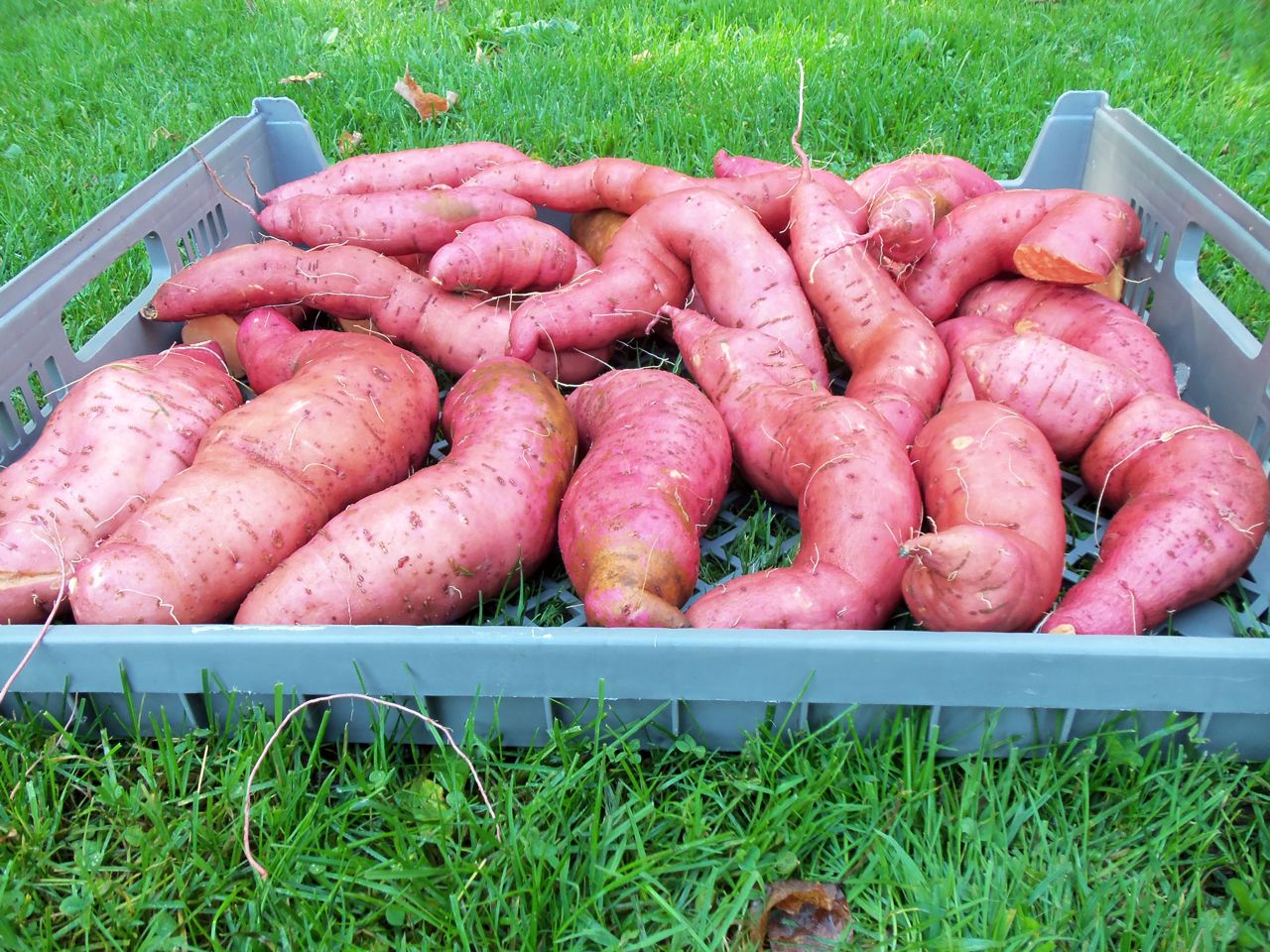
It so happens that sweet potatoes are on my mind because I grew them for the first time this year in my garden here in Central New York state, and I dug them up a few days ago. I couldn't be more pleased with the results....

A portion of my 2011 Sweet potato harvest.

I harvested four bread trays like that from a relatively short row in my garden. The potatoes are huge and beautiful. I will have more to say about growing and curing sweet potatoes in my upcoming October installment of The Deliberate Agrarian blogazine.


###


==========
If you appreciate  Agrarian Nation, please consider supporting this web site with a modest donation of $4.95 a year.  Click Here For Details
==========

07 October 2011

—1857—
Pumpkins

#55

An Old-Timer & His Pumpkins


Pumpkins, probably, are nearly, if not quite, as valuable as the same weight of most kinds of roots, for the purpose of feeding Milch-cows, and fattening cattle; and as they are easily raised, and still easier gathered, it would seem that raising, even the common kinds, might be made profitable. 

In raising a crop, the hills should probably stand about seven feet apart; and, though the crop would require as much ploughing as other hoed crops, yet the expense of hoeing would be but trifling. The crop would not be so expensive to raise, and gather, as a crop of Indian corn; it would exhaust the soil but little, and it would be a fine preparative for wheat, as the ground could be cleared of the crop sufficiently early for sowing that grain. 

It is believed that an acre, properly cultivated, would yield as much as ten tons of even the common kind of pumpkin; and that these would be found worth as much as sixteen cents per hundred, for the purpose of feeding and fattening cattle. The ground should be broken up in the latter end of the preceding autumn; and cross-ploughed just before planting the crop, which should be planted early.
[Maine Farmer's Almanac]


Some people grow giant pumpkins for the fun of it these days but, as this picture shows, that is nothing new. I understand that the really giant pumpkins are not good for eating. They're just good for being big. Methinks I see a metaphor here... Industrialism is like a field with one giant pumpkin, while agrarianism is like a field full of many smaller pumpkins.
###


Pumpkins are a native American vegetable (or would they actually be a fruit?). To the modern mind, pumpkins are primarily a decoration or a seasonal novelty, but in the Agrarian Nation, they were an important source of food for cattle, hogs and people. 

We like pumpkin pies, and the old-timers did too, but "pompkin porridge" was a mainstay on many early farmsteads. 

###

Homegrown pumpkins don't go to waste in my family....


In my family we process pumpkins into a puree that my wife uses to make a pumpkin pudding, which is really good (It might be very similar to pompkin porridge). You can read about how we process the pumpkins and get the pudding recipe at This Blog Post.


###

Field of pumpkins, circa 1895

###

A few years ago I went to a steam show near my home (I wrote about it HERE) and discovered the unusual tool pictured below at a flea market. The vendor told me it was a pumpkin chopper, used to chop pumpkins before feeding to cattle and hogs.

A Pumpkin Chopper from the Agrarian Nation
###

On a subsistence farmstead, when harvesting was done by hand, it was a common practice to plant corn, beans and pumpkins together in a field. This was an Indian custom that the settlers adopted. This excerpt from the book, A Long Deep Furrow, explains....

On old land the best culture practice was to plow, crossplow, harrow smooth, then furrow and crossfurrow at intervals from 3 to 4-1/2 feet according to the quality of soil, and plant at the intersections. After the corn plants came up, light furrows plowed lengthwise between the rows threw the earth toward the hill, followed by hoeing to kill or cover weeds. After these first cultivations the hoe was used once, sometimes twice, according to need. Bean vines twined up the cornstalks, and pumpkin seeds planted at intervals provided foliage to cover the ground for the final weeks, smother weeds, and produce welcome additional food.
When the corn was planted at intersections of the crossfurrow grid, more than one seed was planted. And when it speaks of throwing earth toward the hill, it is not speaking of a raised portion of ground. "Hill" was a place where more than a single seed was planted. It need not have been raised, though it often became a raised spot as soil was hoed up around the growing plant. See this old definition.

Having Fun With Pumpkins


==========
If you appreciate  Agrarian Nation, please consider supporting this web site with a modest donation of $4.95 a year.  Click Here For Details
==========